


The start of the campaign

For the process of researching the issues this week, I mainly focused on articles as well as some scholarly sources in order for me to talk about the issues that cetaceans face. Although I did not necessarily use the databases provided, the articles I found often provided me with the best sources. In an article "Ships' noise is serious problem for killer whales and dolphins, report finds" by The Guardian, I managed to find a researcher in the field with a published study about the issue " Ship noise extends to frequencies used for echolocation by endangered killer whales." After skim-reading it, I thought it would be good source, since the article talked highly of it and was the discussion of the article. It also helps since I have found other interesting previously established pieces in sources that were cited in the experimental study. There are various problems that cetaceans overall outside and inside captivity.
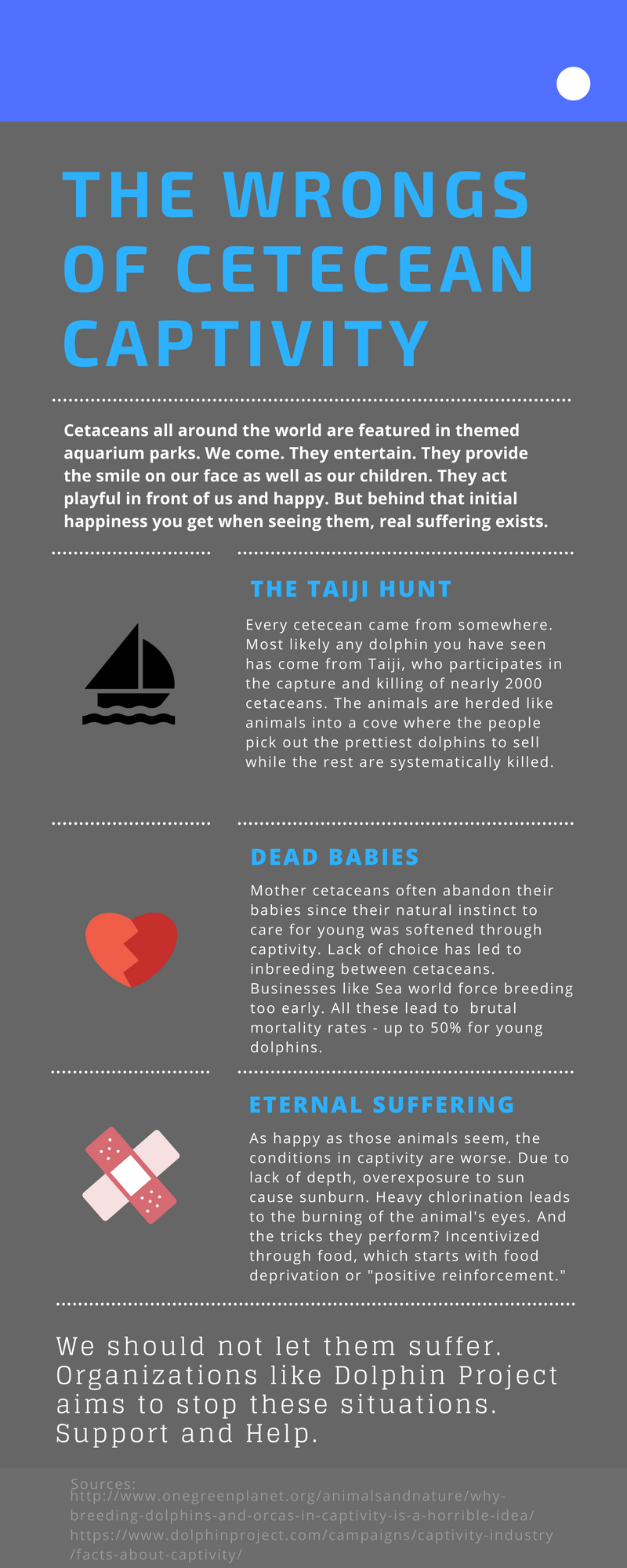
Through the dolphin project in particular, I managed to grasp on the problems that dolphins in captivity face. The info-graphic displays all that I have learned about the problems, but they are much more that were not covered in the info graphic. I just highlighted the important ones, deterioration in physical conditions due to treatment, high stress with unnatural pregnancies, and the most well known due to "The Cove," the Taiji hunt. The problems themselves feel very difficult to solve without research, and the field for solutions seems a bit rare. The eternal suffering segment of the info-graphic are not easy issues to solve, heavy protesting and decision by aquarium owners would have to be required in order for the cetacean's captivity conditions to be better. The pregnancies are easy to solve. Stop breeding the dolphins and put them on birth control. However, most of the time the businesses that own the dolphins breed for money, it doesn't matter how much the mother suffers, it's how much money they can squeeze out of the cetacean before they die. The Taiji hunt is the most difficult to solve. This is because the control over the hunt is not business related, given enough pressure the businesses will relent to the people. But going against the Japanese government is particularly difficult. Especially when the Japanese themselves has made another town similar to Taiji start practicing similar traditions with Taiji, in order to not be culturally isolated and as a guise that it is "normal." The issues with dolphins outside captivity are a bit easier. They face issues such as climate change, pollution and noise. The one in particular that I would like to focus on would be noise, due to the fact that I found many sources for noise pollution and it has a relatively easy solution to implement. The military does not need to go that fast with their ships in a non war state. It's possible to have them lessen the noise with signals or implement other forms of communications that does not harm cetaceans.
For the two organizations, we decided to adopt the Marine Mammal Organization and The dolphin project. Both of the organizations focused on similar issues, but the dolphin project in particular caught my eye. This is due to their work on the Taiji hunt issue, and their ongoing protest against the hunt, with even their founder being imprisoned for protesting about it. They also are one of the biggest organizations for cetacean issues. The marine mammal organization, while smaller also covered the same topics but with more focus on dolphin captivity. One of their projects, Keiko Whale rescue, focuses on the statements Seaworld makes about their conditions of their cetaceans which are often false.
Group tweets: https://docs.google.com/document/d/1l3IoRF54uAtl4ZXIOJWBYs00CTpLGy6OO4pTFrjbsU0/edit
Comments